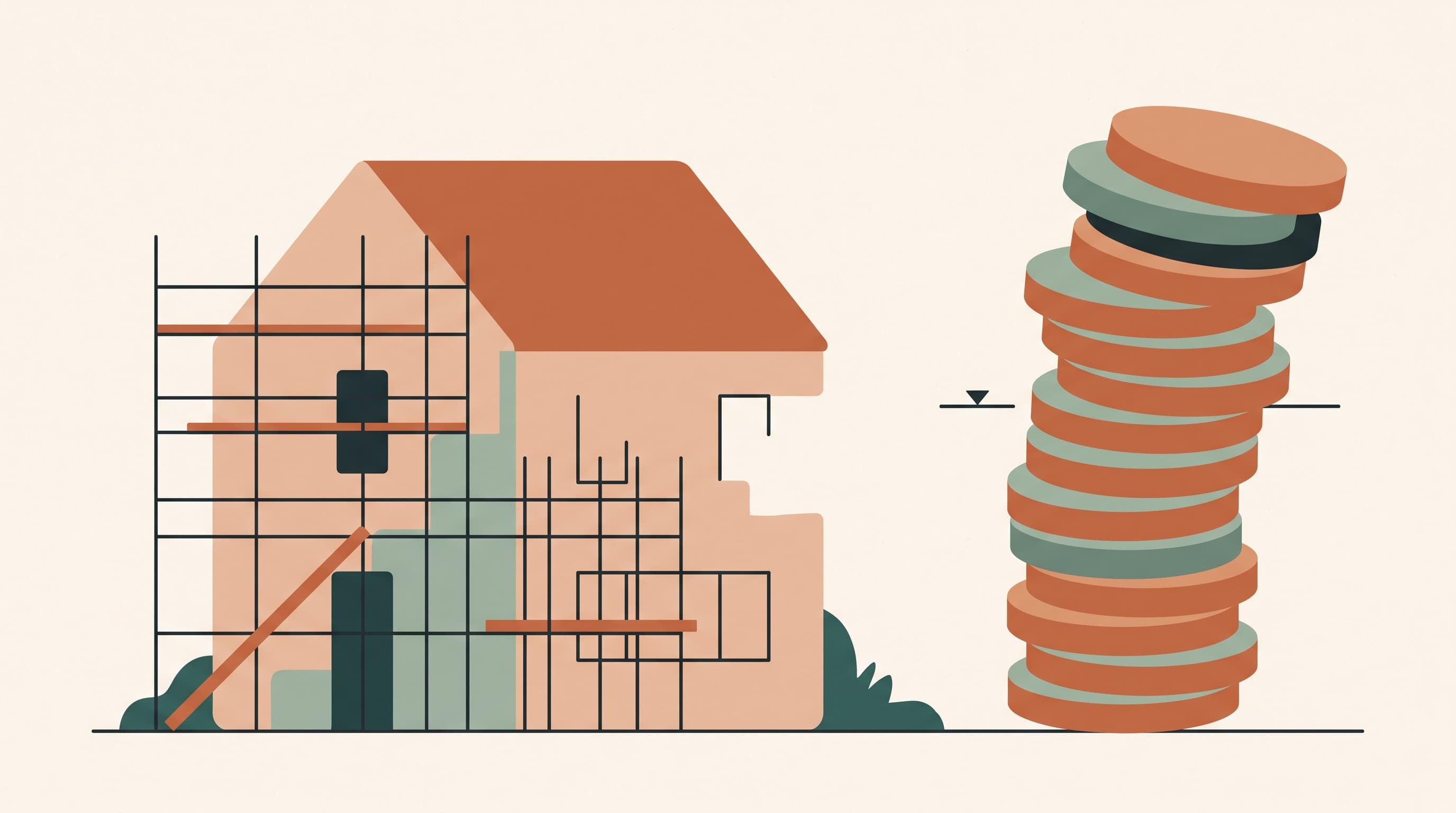
You have signed your construction loan, the first contractor invoices are on the table and your savings account holds the money you are putting in yourself. And then comes the question every builder or renovator faces sooner or later: do I pay this invoice from my savings, or do I send it to the bank for a drawdown on the loan?
That choice is less free than it looks. Banks set conditions on invoices, charge fees on money you have not yet drawn and apply a deadline within which you have to use the loan. If you do not follow this up properly, you pay too much or lose track of two sources of money at the same time.
In this article you will read how a mortgage construction loan paid out in instalments works, which rules apply to invoices you have already paid yourself, and how to track loan and own funds side by side without spreadsheet headaches. At the bottom you will find a simple way to keep that overview with a tool.
How does a construction loan in instalments work?
A mortgage construction loan (also called a building credit or a credit facility for building or renovation) is usually not paid out in one go. The bank makes a credit line available and releases it in instalments, each time you prove that work has been carried out or materials have been purchased. You provide that proof with invoices, advance invoices or purchase receipts, sometimes supplemented with photos of the site. [1] [2]
That system has a logical reason: the bank wants to be sure the money actually goes into your home. The European framework for home loans, the Mortgage Credit Directive, sets the basic rules for consumer protection and information duties, but leaves the practical handling of instalment drawdowns to national legislation and the banks themselves. [3] That is why the details differ per country and per bank, while the principle stays the same everywhere: no invoice, no drawdown.
What do you pay during the drawdown phase?
As long as you have not fully drawn the loan, you usually pay interest only on the part that has already been paid out. On top of that, many banks charge a commitment fee (also called a reservation fee) on the part that has not yet been drawn. In one Belgian prospectus, for example, it amounts to 0.2 percent per month on the undrawn amount, which comes down to roughly 2.4 percent per year. [4] The exact percentage differs per bank and per product, so check it in your own credit offer.
One credit line, two costs
Example: a credit line of € 250,000 of which € 150,000 has already been drawn. You pay interest on that drawn part. On the € 100,000 still open, many banks charge a commitment fee during the drawdown phase. So both costs run at the same time, until the loan is fully drawn.
Only after the drawdown period does the regular repayment of capital and interest over the remaining term begin. [1]
How long can you draw down?
Banks build in a drawdown period. According to Wikifin, the financial education platform of the Belgian supervisor, it is usually around 12 months, with the possibility of an extension. [1] A comparison of Belgian banks by De Tijd from 2017 showed maximums between 24 and 36 months, depending on the institution. [5] Those figures may have changed since, but the message remains: the period is limited and it is in your contract.
If you exceed the deadline, you risk the remaining amount lapsing or the conditions having to be renegotiated. [1] Minimum amounts per instalment also occur, for example 2,000 euros per drawdown. [2] [4]
Which invoices can you send to the bank?
This is where things often go wrong, because the rules differ per bank and are rarely listed in one overview. Still, a few recurring requirements emerge from the conditions of Belgian lenders: [6] [7]
- The invoice is in the name of (one of) the borrowers.
- The description matches the purpose of the credit: work or materials for the home you are borrowing for.
- The invoice is recent and sufficiently detailed.
- At many banks, the invoice must not yet have been paid with own funds.
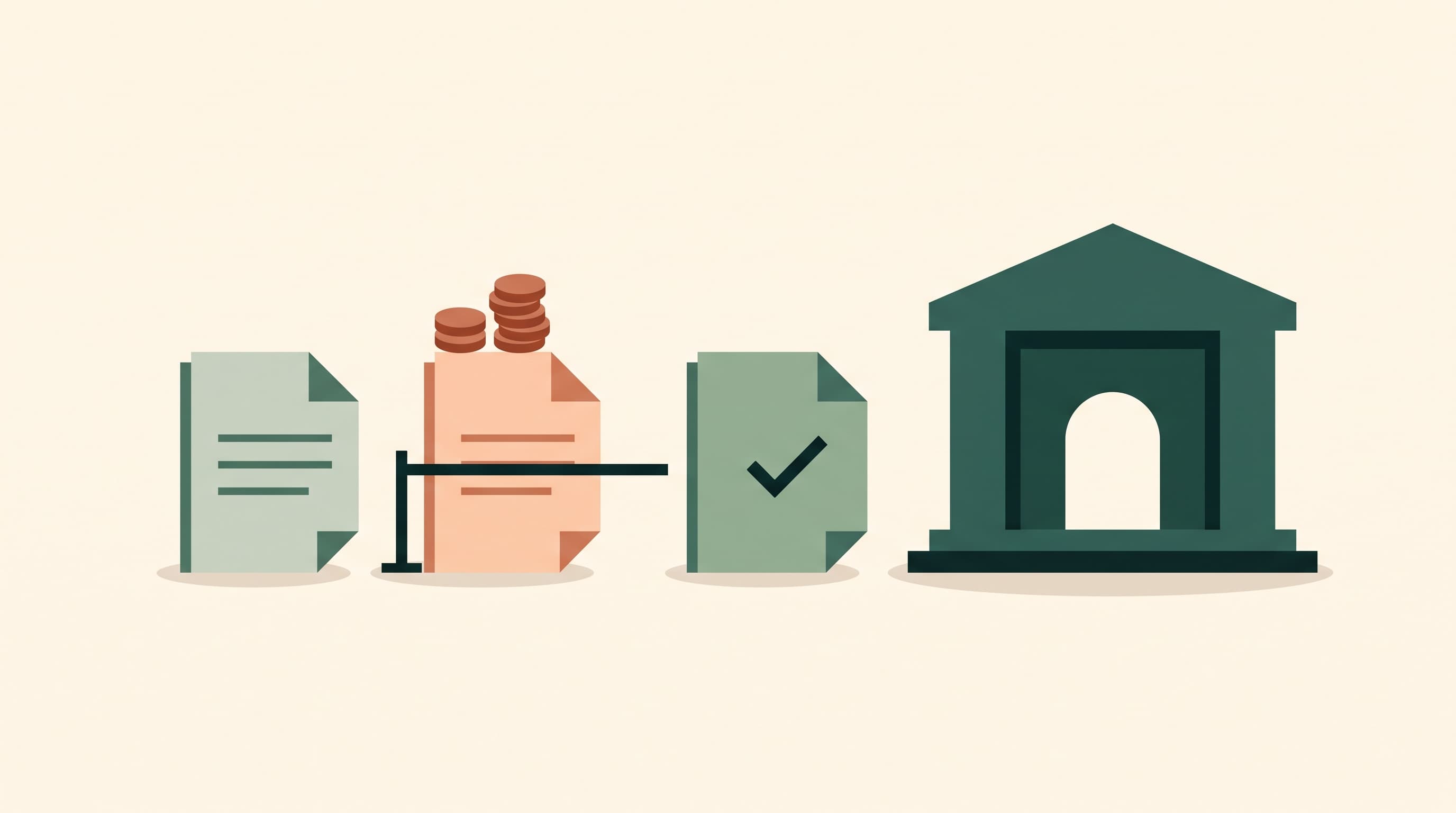
That last rule is the most important one for anyone combining savings and a loan. Some banks let you choose after approval whether the amount lands in your own account or goes directly to the supplier. [6] Other lenders pay almost exclusively directly to suppliers or through the notary, and transfer only a limited amount to your own account for smaller invoices. [7]
What if you have already paid an invoice with savings?
Then it depends on your bank. Some banks allow a reimbursement through the credit, but often limit it to a part of the credit amount and to invoices no older than six months. [9] Other banks exclude invoices that have already been paid. [6] So ask about this before you pay the first invoice yourself, not after. And keep in mind that the tax treatment of such reimbursements can differ per country.
Why you should not run your savings too low
It is tempting to pay invoices quickly yourself and leave the loan untouched for as long as possible. That way you avoid interest. But you do pay a commitment fee on the undrawn part, and your savings buffer shrinks while the site is still running.
That buffer is thinner in many households than you might think. According to Eurostat, in 2020, 46.2 percent of the EU population could maintain their standard of living for less than three months from savings, and 46.9 percent could set money aside in a typical month. [10] At the same time, home loans are the dominant debt of European households: in 2022, mortgages accounted for 79 percent of the volume of loans to households according to the European Banking Authority. [11]
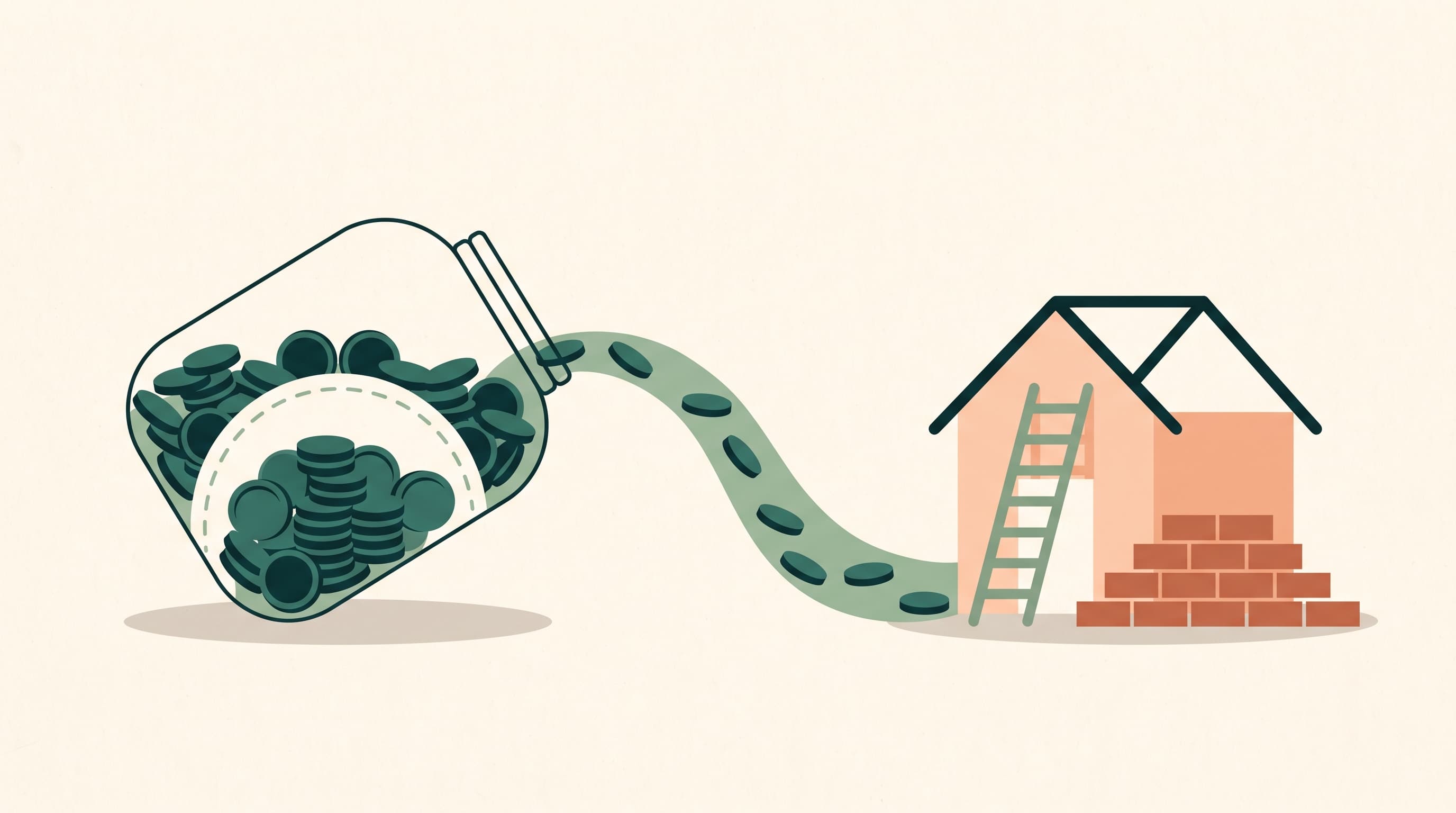
A building project also always brings unexpected costs: extra work that was not in the quote, a supplier asking for an advance. If you put all your savings into the site, you have no room left for those surprises, and none for a broken washing machine at home either.
So the trade-off is not a matter of loan or savings, but of timing and distribution. What is best for you depends on your interest rate, your tax situation and your country. You can, however, work along a few general principles.
Step-by-step plan: tracking loan and own funds side by side
Step 1: Know the rules of your own bank
Re-read your credit offer on four points: the drawdown period, the commitment fee, the minimum amount per instalment and the conditions for invoices. Ask explicitly what happens to invoices you have already paid yourself. Write the answers down in one place, so you do not have to look them up again every time.
Step 2: Decide in advance which buffer you will not touch
Determine which amount of your savings is meant for the build and which part remains an emergency buffer. Many people skip that step and only notice halfway through that the buffer is gone. Also agree on who in the household decides about exceptions.
Step 3: Decide per invoice, not per month
Look at each invoice separately: can it go to the bank, and do you want it to? Large contractor invoices usually lend themselves well to a credit drawdown, because they are in your name and clearly described. Small purchases at the DIY store are often easier from own funds, especially if your bank applies a minimum amount per instalment. If you choose the loan, do not pay the invoice yourself first, unless your bank explicitly allows that.
Step 4: Record which invoice went through which source
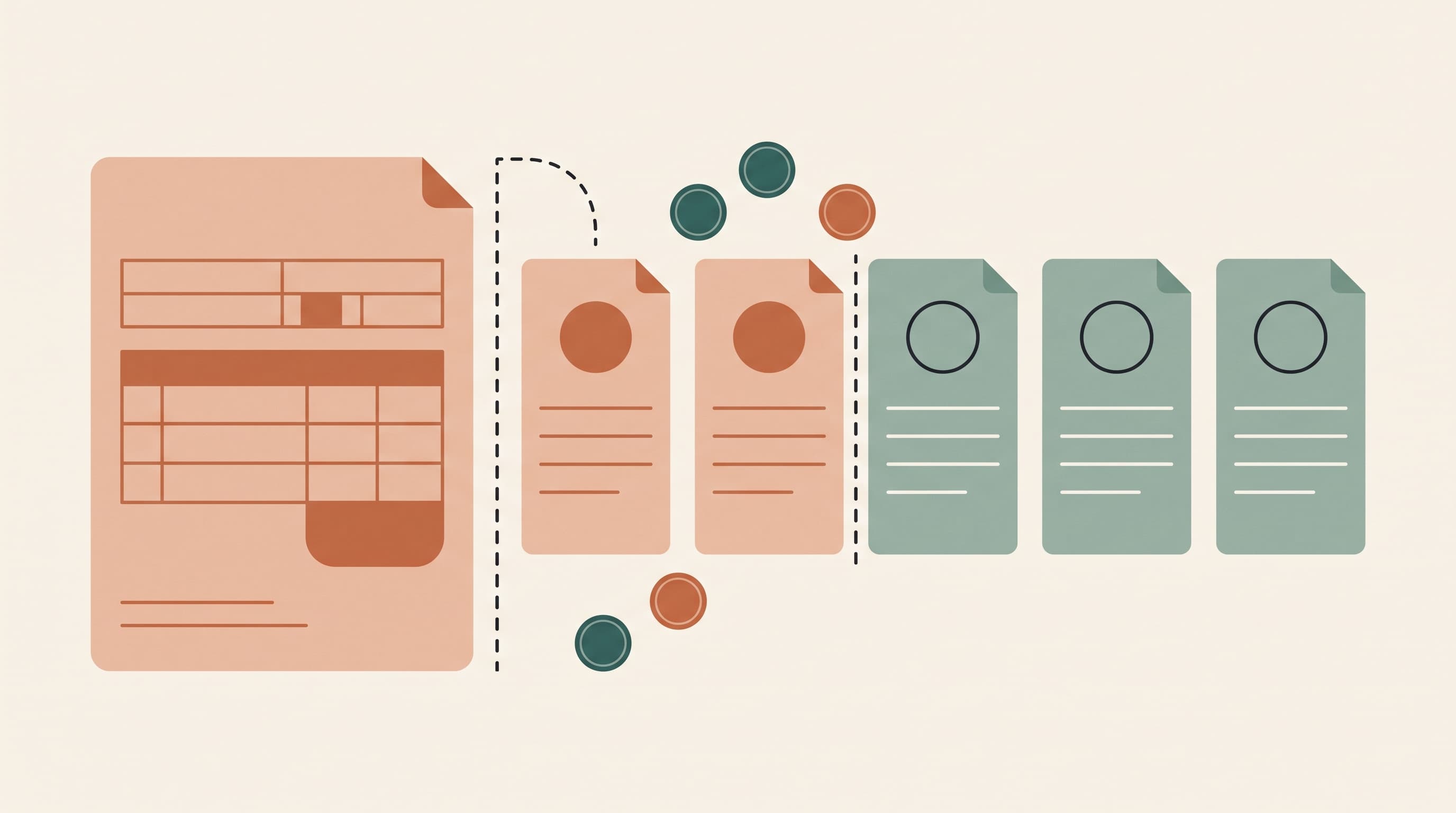
This is the step almost everyone underestimates. After a few months you have dozens of invoices, advances, partial invoices and credit notes, spread over two sources of money. For each invoice, record the date, the supplier, the invoice number, the amount, the budget line and the funding source (loan, own funds or a combination), and keep the PDF file with it. That way you know at any moment how much credit is still available, how much savings remain and which invoices have already been submitted to the bank.
Step 5: Watch the drawdown deadline
Put the end date of your drawdown period in your calendar and plan your large drawdowns around it. If the site runs late, contact your bank in good time about an extension. Do not wait until the final month.
How a digital tool simplifies the overview
The bank increasingly handles its part of the puzzle digitally: at some banks you simply upload invoices in the app and immediately choose how the amount is paid out. [6] But that only solves one side. What the bank does not keep for you is your own total picture: how much you budgeted per budget line, what you have already spent from the loan and from your savings, and how much is still locked into quotes you have approved.
Many builders and renovators do that in a spreadsheet combined with a digital folder full of PDF documents. That works until the moment the contractor calls about invoice 2026038 and you are standing on the site without a laptop.
If you would rather keep all of that in one place, you can do so with a tool like PiggyPlanr. In build mode, the dashboard shows two cards side by side, loan and own contribution, each with total, used, reserved and remaining. For every invoice you choose the funding source (loan, own funds or a combination) and attach the PDF, so afterwards you know exactly which invoices went through the credit and which you paid yourself. Searching by invoice number or filtering by supplier takes a few seconds, and it works just as well on your smartphone. A selected quote also already reserves budget on the relevant line, even before the invoice arrives. When an advance invoice comes in, you convert part of the quote and that amount automatically moves from reserved to spent.
One thing PiggyPlanr deliberately does not do, to guarantee your safety and privacy: the app does not connect to your bank and does not submit invoices. Requesting your credit instalments stays within your bank's own channels. PiggyPlanr is the overview you keep alongside it, without having to give an app access to your bank account.
What changes when you work this way?
After a few months you notice the difference mostly in peace of mind: with every new invoice you immediately know whether it can go to the bank and whether there is budget for it. Halfway through the project you see which lines still have room, which are going over budget and how much credit is still open against the drawdown deadline. That is the moment you can still steer. At completion you have a complete file: every invoice with its PDF, the source it was paid from and the total picture of loan and own contribution. Handy for yourself, often necessary for government bodies and very useful when questions come up and you need to look something up quickly in your records.
In closing
A construction loan in instalments is manageable once you know the rules of the game: invoices in your name and not yet paid yourself, a limited drawdown period and a commitment fee on what you have not yet drawn. Combine that with a clear decision about which savings you use and which buffer you protect, and record for each invoice which source paid it. With that foundation you take every invoice decision consciously, instead of having to reconstruct afterwards how it all went.
Want to see loan and own funds side by side, with every invoice and its funding source in one place? You can try PiggyPlanr free for 14 days, no payment details required.
Sources
- Wikifin (FSMA), "Een kredietopening om te bouwen of renoveren". https://www.wikifin.be/nl/woning-en-hypothecaire-lening/hypothecaire-lening/bouw-en-renovatie/een-kredietopening-om-te-bouwen
- BankB, "Bouwschijven" (procedure and supporting documents). https://www.bankb.be/nl-be/bouwschijven
- Directive 2014/17/EU (Mortgage Credit Directive). https://eur-lex.europa.eu/legal-content/EN/TXT/?uri=CELEX:32014L0017
- Hypotheekwinkel, "Prospectus hypothecaire kredieten" (PDF, undated). https://www.hypotheekwinkel.be/content/uploads/2022/12/prospectus%20(6).pdf
- De Tijd / Netto, "Wat de bank u niet vertelt over uw bouwlening", 2017. https://www.tijd.be/netto/dossier/bouwgids2017/wat-de-bank-u-niet-vertelt-over-uw-bouwlening/9864009.html
- KBC, "Hypothecaire lening in schijven opnemen". https://www.kbc.be/particulieren/nl/lenen/wonen/hypothecaire-lening-opnemen.html
- Vlaams Woningfonds, "Veelgestelde vragen Vlaamse woonlening". https://www.vlaamswoningfonds.be/woonkrediet/veelgestelde-vragen
- MeDirect (Malta), "Home Loans Request for Drawdown Form" (PDF). https://www.medirect.com.mt/wp-content/uploads/Home-Loans-Request-for-Drawdown-Form.pdf
- Bank Van Breda, "Informatie uitbetaling via online banking" (PDF). https://content.bankvanbreda.be/hubfs/Informatie%20uitbetaling%20via%20online%20banking%20BdK.pdf
- Eurostat, "Financial vulnerability in households" (EU-SILC 2020). https://ec.europa.eu/eurostat/statistics-explained/index.php?title=Financial_vulnerability_in_households
- European Banking Authority, "Consumer Trends Report 2022/23". https://www.eba.europa.eu/sites/default/files/document_library/Publications/Reports/2023/1054879/Consumer%20Trends%20Report%202022-2023.pdf
Frequently asked questions
What is a construction loan in instalments?
A mortgage loan for building or renovation that is not paid out in one go, but in parts as the work progresses. You request each drawdown with invoices or other supporting documents.
How long can I draw down my construction loan?
That is set in your contract. In Belgian examples, the period varies from about 12 months (with a possible extension) to 24 or 36 months.
Which invoices can I submit to the bank?
Usually invoices in the borrower's name, with a description that matches the purpose of the credit, and that have not yet been paid with own funds. The exact conditions differ per bank.
Can invoices I already paid with savings still be reimbursed through the construction loan?
Some banks allow it to a limited extent and under conditions, others do not. Ask before you pay.
What is a commitment fee and how much does it cost?
A fee the bank charges on the part of the loan you have not yet drawn. In one Belgian example it is 0.2 percent per month; your own credit offer states the exact rate.