Your monthly budget adds up. The rent or mortgage is paid, the groceries fit in and there is even something left over. And then the annual settlement from your energy supplier lands in your mailbox. Or the yearly premium for your car insurance. Or the tax assessment. Suddenly hundreds of euros are due at once, and none of that money was ever set aside.
The good news: these bills are not bad luck, they are predictable. In this article you will learn what provision expenses are, why big bills have been hitting harder in recent years, and how the 1/12 method turns every annual cost into a manageable monthly amount. At the bottom you will also find a simple way to keep track of all this without any spreadsheet work.
What are provision expenses?
Besides your monthly fixed costs, every household has costs that come back only once or a few times a year. Think of the annual settlement of your energy contract, insurance premiums, tax assessments, home or car maintenance, school costs and the yearly holiday.
The Dutch budget institute Nibud calls these provision expenses ("reserveringsuitgaven"): expenses that do not occur every month, but are predictable enough to save for in advance.
That is exactly where it pinches. Most people budget per month, while these costs live per year. If you do not work them into your monthly budget, every big bill feels like a surprise, even though it was basically on the calendar all along.
Why big bills hit harder these days
Annual costs are not only large, they also fluctuate. Energy prices are the clearest example. According to Eurostat, European households paid an average of €28.96 per 100 kWh of electricity in the second half of 2025, still clearly above the level from before the 2022 energy crisis.
Behind that average, moreover, hide large differences. Prices ranged from €10.82 per 100 kWh in Hungary to €40.42 in Ireland, and in Romania they rose by 58.6% in a single year.
General inflation also tells only half the story. The ECB reports that euro area inflation fell from 2.4% in 2024 to 2.1% in 2025, with a projection of 1.9% for 2026. But the spread between countries remained wide: in April 2025, annual inflation varied from 0.9% in France to 4.9% in Romania.
The lesson: a stable European average does not guarantee that your settlement or annual premium stays stable. Setting money aside based on your own numbers is therefore no unnecessary luxury.
Buffer versus provision: the difference
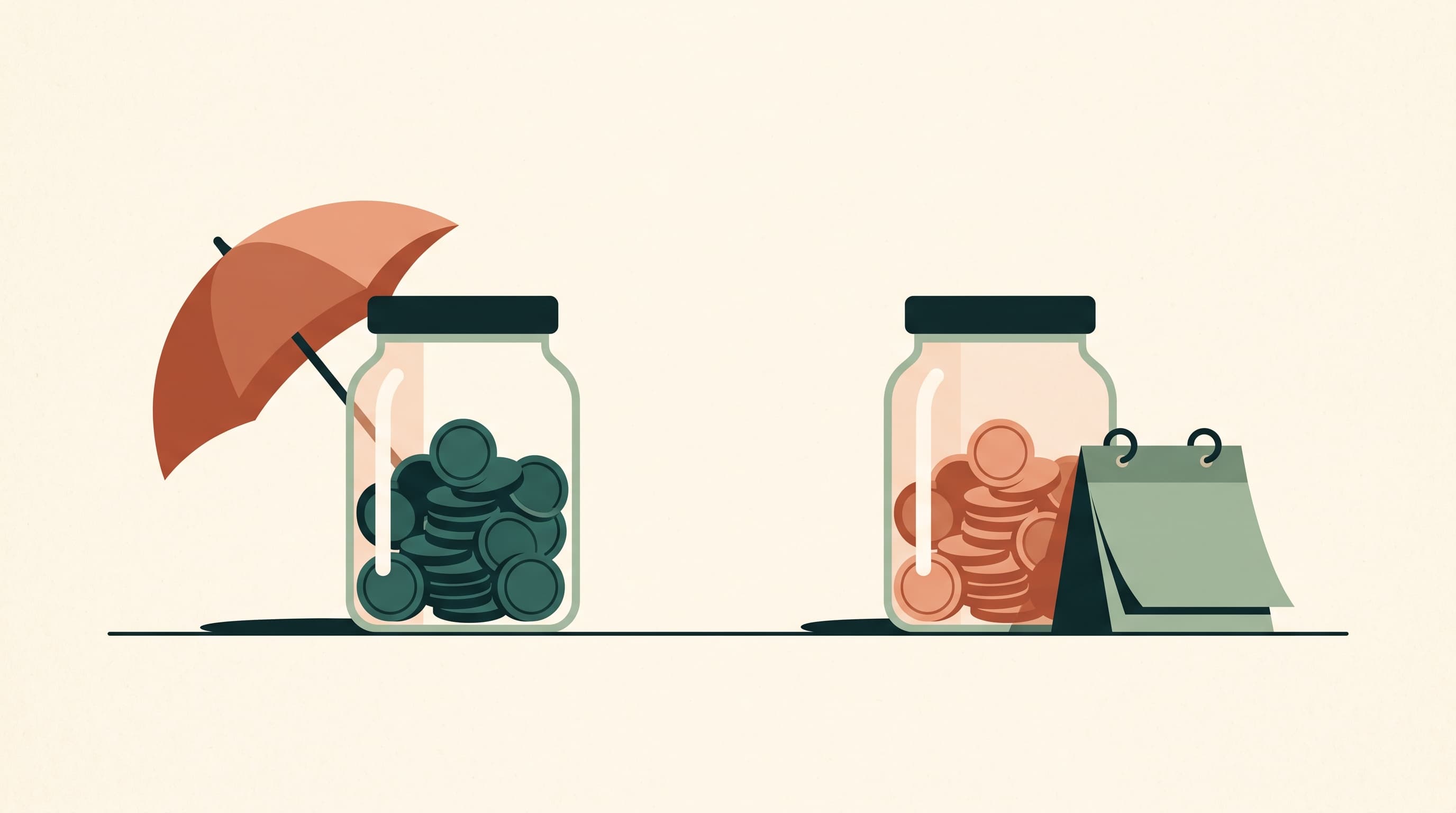
These two concepts are often mixed up, and that is a pity, because they each do something different.
A financial buffer is for unforeseen costs: the washing machine that breaks down, an urgent car repair. You do not know what is coming or when. As a rule of thumb, the Dutch institute Nibud advises structurally saving at least 10% of your net income to build up such a buffer and keep it topped up.
A provision is for predictable costs: you know the insurance premium and the settlement are coming, and you know roughly how big they are. So you save for them in a targeted, calculated way.
If you throw both onto one pile, you will see your buffer drain every time for bills that could simply have been planned. So keep them apart: a buffer for the unexpected, provisions for the expected.
The 1/12 method: calculate your annual provision in four steps
The core method from the budgeting literature is surprisingly simple and is recommended by, among others, the Dutch budget institute Nibud.
Step 1: take stock of your annual costs
Go through your bank statements from the past twelve months and note every expense that does not come back monthly: premiums, settlements, taxes, maintenance, school costs, holiday.
Step 2: convert each cost separately into a monthly amount
Divide each annual cost by twelve, a half-yearly one by six and a quarterly one by three. For amounts that fluctuate, round up rather than down: better a small windfall than a shortfall.
A worked example, purely as an illustration: €700 of insurance premiums becomes €58.33 per month, a €400 margin for the energy settlement becomes €33.33, €500 of car maintenance becomes €41.67, €300 of school costs becomes €25 and €1,100 of holiday becomes €91.67. Together: €250 per month.
The 1/12 method in practice
Worked example from the article: each annual amount divided by twelve.
Step 3: give every cost item its own pot
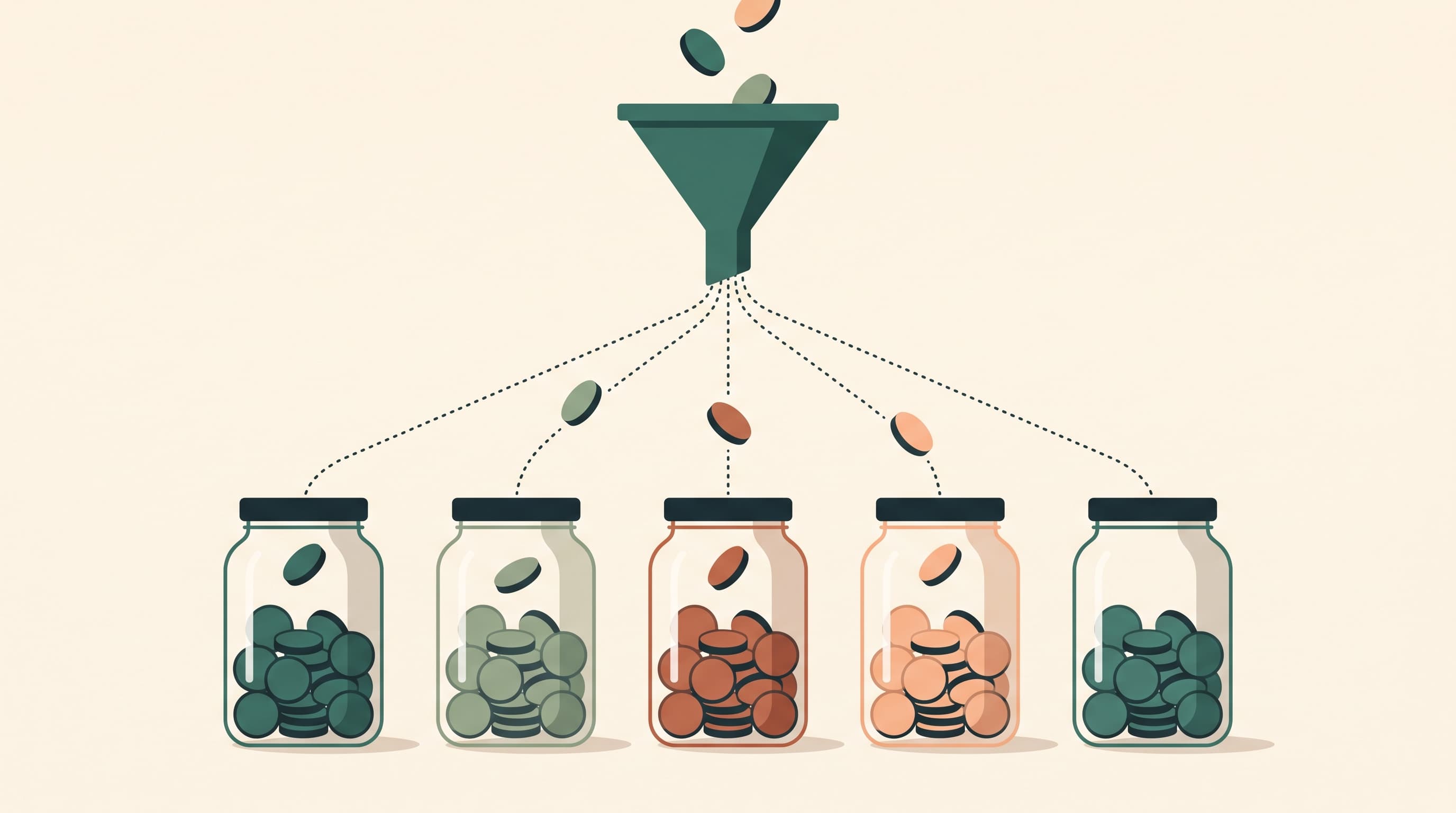
Do not put those monthly amounts on one big savings pile, but give every cost its own pot. That way you can see exactly how much is already waiting for your insurance and how much for your energy, and with every bill you take the money from the right pot. It keeps your provisions clear and motivating: you see each pot grow towards its goal month after month.
Step 4: automate the transfer
Set the total monthly amount aside automatically every month, preferably on the day your salary comes in. That way the money never gets a chance to go to something else. Automation is the key to keeping this up.
How to keep it up: from savings account to app
The method itself works anywhere: a separate savings account, a spreadsheet or a budget app. In practice the system usually does not fail at the calculating, but at the keeping up.
If you would rather not do that calculating and tracking by hand, you can make the process a lot easier with PiggyPlanr. The tool is built around exactly this principle: you distribute your income in advance over pots that each keep their own running balance, so that reserved money visibly sits apart and grows until the big bill arrives.
The built-in Calculator also does exactly what step 2 above describes: you indicate that a cost is annual, half-yearly or quarterly, type in the amount and the app converts it into your monthly amount. An annual cost of €1,187 becomes €98.92 per month, or €100 rounded. After that, you process your salary, budgets and fixed costs each month in one guided flow, and per account you see the expected balance next to the actual balance. Forgotten transactions or bank charges stand out immediately.
Good to know: you do not have to give the app access to your bank account. No bank connection is needed, you enter transactions yourself or have them read from a screenshot of your bank statement. Especially that last option saves a lot of work: the app reads the statement automatically and lines up the transactions for you, so keeping track takes hardly any effort. Around five minutes a week is enough to keep your household finances in order. And you can spend those five minutes anywhere, because the app simply works in your smartphone's browser: in the waiting room, on the train or at home on the couch.
What do you notice after three, six and twelve months?
Take the worked example from above: €3,000 of annual costs, so €250 set aside per month.
After three months your system is in place. Each pot holds three monthly contributions: €175 for the insurance, €275 for the holiday, €75 for the school costs. So you see not only that money is being reserved, but exactly what for.
After six months you pay a first big bill directly from its matching pot, while the other pots simply keep growing. If a bill arrives before its pot is completely full, that evens itself out over the course of the year, because your monthly contribution keeps running.
After twelve months the circle is complete: €3,000 of predictable costs paid, each from its own pot, without having to shuffle your monthly budget even once. Your buffer stayed untouched for real surprises, and with every purchase you know how much money is truly free.
Conclusion: predictable costs deserve a plan
Big annual bills are rarely real surprises, they are mostly costs that were not in the monthly budget. If you know your provision expenses, convert each cost into a monthly amount in its own pot and automate the transfer, you take the fright out of every envelope. In addition, keep your buffer separate for what you truly cannot see coming. With the steps in this article you can start today.
Sources
- Nibud, Stappenplan Jaarbegroting maken (provision expenses and the 1/12 method, in Dutch)
- Nibud, Stappenplan Maandelijks geld opzij zetten (advice to save at least 10% of net income, in Dutch)
- Eurostat, EU household electricity prices stable in 2025 (electricity prices in the second half of 2025, spread between EU countries)
- ECB, Annual Report 2025 (euro area inflation 2024-2026)
- Eurostat, Annual inflation stable at 2.2% in the euro area (national inflation spread, April 2025)
Frequently asked questions
What are provision expenses?
Provision expenses are costs that do not occur every month but are predictable enough to save for in advance. Think of the annual settlement of your energy contract, insurance premiums, tax assessments, home or car maintenance, school costs and the yearly holiday. The term comes from the Dutch budget institute Nibud.
What is the difference between a buffer and a provision?
A buffer is for unforeseen costs: the washing machine that breaks down or an urgent repair. You do not know what is coming or when. A provision is for predictable costs: you know the premium or settlement is coming and roughly how big it is, so you save for it in a targeted way. Keep them apart, otherwise your buffer drains every time for bills that could simply have been planned.
How do you convert an annual cost into a monthly amount?
With the 1/12 method: divide an annual cost by twelve, a half-yearly one by six and a quarterly one by three. An insurance premium of 700 euros per year becomes 58.33 euros per month. Round fluctuating amounts up: better a small windfall than a shortfall.
Why give every cost item its own pot?
With a separate pot per cost you see exactly how much is already waiting for your insurance and how much for your energy, and with every bill you take the money from the right pot. That keeps your provisions clear and motivating: you see each pot grow towards its goal month after month, while one big savings pile gives no view of what is already spoken for.