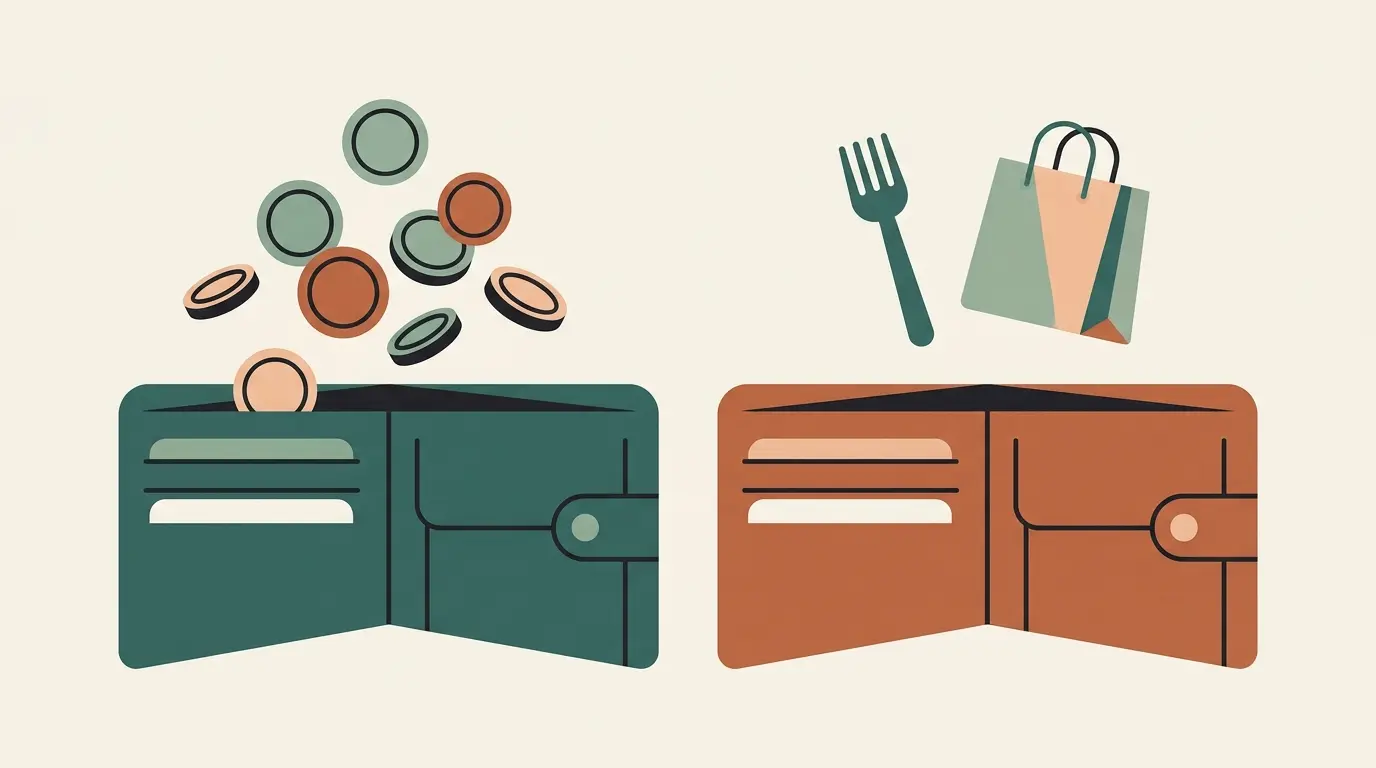
You earn more than your partner, or just less. The rent, the energy bill and the groceries come back every month, and somewhere the question nags: do we pay everything fifty-fifty, or is that unfair when our incomes differ? Online you often read that splitting by income is the one fair solution. Yet representative research shows a more surprising picture: the method that sounds most logical does not always feel the fairest in practice.
In this article you get the four most used methods for splitting costs when living together, each with a concrete calculation example. You'll see what couples themselves find fairest, what the legal situation is and how to make agreements in five steps that keep working. At the bottom you'll also find a simple way to track the split without Excel work.
Why splitting costs gets sensitive once incomes differ
Most couples start without a plan. The Nibud study "Geld & Relatie" (2019, representative sample of 770 Dutch respondents) shows that only 57 percent of couples have made explicit agreements about money matters. The most cited reason for not doing so: "it will sort itself out". The same study shows that 27 percent of couples sometimes disagree about money, mainly about cutting back and about their partner's spending pattern.
Without agreements, a split quietly grows lopsided. The partner who happens to advance the groceries keeps doing so. The higher earner pays for the holiday "because it's easier anyway". After a few years, nobody knows who carries what anymore, and that is exactly the breeding ground for resentment.
The income gap itself is no coincidence either. According to Eurostat, the pay gap between men and women in the EU was 11.1 percent in 2024. Women are therefore statistically more often the lower-earning partner, which also gives fair splitting a structural dimension.
The four most used methods for splitting costs
Research and practical guides keep surfacing the same four basic methods. For the calculation examples we assume a fictional couple: partner A earns 2,600 euros net per month, partner B 1,900 euros, and their shared costs amount to 2,500 euros.
1. The 50/50 split
Each pays exactly half of every shared cost, regardless of income. Partner A and partner B each put in 1,250 euros. Simple and transparent, but the burden does not weigh equally: after the shared costs B keeps 650 euros, A keeps 1,350 euros.
The 50/50 split
Each pays exactly half. A keeps € 1,350, B € 650.
2. Splitting in proportion to income (pro rata)
Each partner contributes a percentage equal to his or her share of the total income. A earns 58 percent of the combined income of 4,500 euros and therefore pays 58 percent of the costs: about 1,445 euros. B pays 42 percent: about 1,055 euros. The relative effort is equal, though this method does require you to keep the calculation up to date whenever an income changes.
Pro rata to income
Each by their share of income: A 58%, B 42%.
3. The joint pot
Both incomes go entirely into one account and all expenses, shared and personal alike, are paid from it. There is nothing to settle up. This is by far the most popular method: 61 percent of couples in the Nibud study choose it.
The joint pot
Both salaries into one account, nothing to settle up.
4. Keeping the same amount left over
You add up both incomes, subtract all shared costs and split what remains equally. In our example 2,000 euros remain, so each gets 1,000 euros to spend freely. A therefore contributes 1,600 euros to the costs, B 900 euros. Neither has more "spending money" than the other.
Keeping the same amount left over
Each keeps exactly € 1,000 to spend freely.
Many couples also choose a hybrid form: the rent 50/50, for instance, and the costs for the children pro rata to income. So you don't have to apply one method to everything.
What couples themselves find fairest: the numbers surprise
Many blogs and apps present the pro rata split as the fairest choice when incomes differ. Important to know: those sources are almost always content marketing without their own research data. The only representative study found on perceived fairness, the Nibud report from 2019 mentioned above, tells a different story.
Users of the joint pot most often experience their method as fair: 84 percent. The 50/50 split follows with 81 percent. The pro rata split scores lower at 76 percent, and "keeping the same amount left over" closes the ranks at 68 percent. The method that looks most refined on paper does not feel the fairest to its own users.
There is no conclusive explanation. Possibly couples choose more complex methods precisely when tension about money already exists. What the data does make clear: there is no proven "best" method, and there is no research showing that one splitting method leads to happier relationships. Fair is what the two of you, with open cards, find fair. One caveat: the Nibud study is Dutch and dates from 2019, so the exact percentages may be different today.
Does it legally have to be 50/50?
No. An equal contribution in absolute amounts is not legally required anywhere. In many European countries, the opposite principle even applies to married couples: partners contribute according to their means. In Belgium, the Civil Code stipulates that each spouse contributes "according to their means", and in the Netherlands a comparable duty to contribute proportionally applies. So the higher earner may legally contribute more.
For unmarried cohabitants it is different. Depending on the country and the form of cohabitation, there is sometimes no legal duty to contribute at all. In Belgium, for example, de facto cohabitants have no legal obligations towards each other, however long the relationship lasts. Everything then depends on your own agreements. All the more reason to make those agreements consciously and put them in writing, especially for the partner with the lowest income. The exact rules differ per country; check them for your situation or record your agreements in a cohabitation contract.
Five steps towards agreements that keep working

Step 1: decide together what counts as "shared"
Make a list of what you consider shared costs: rent or mortgage, energy, groceries, insurance, internet. Also agree on what stays personal, such as clothing, hobbies and individual subscriptions. This list prevents half of the discussions.
Step 2: don't forget the irregular costs
A car repair, the annual insurance premium, the holiday: whoever only looks at monthly costs ends up lopsided as soon as a big expense lands. Set aside a fixed amount every month for these items and include it in the split.
Step 3: pick a method and run the numbers
Take the four methods above and calculate each scenario with your real figures. Don't just look at the amounts, but also at how it feels. A split that adds up mathematically but chafes won't last. And remember: combining per cost item is allowed.
Step 4: record the agreements and plan a regular money moment
Put the chosen split down in black and white in a shared document. Nibud advises couples to talk about money matters at least monthly. Fifteen minutes over coffee is enough to check whether everything still adds up.
Step 5: revisit the split at every change
A pay rise, parental leave, a switch to part-time work: every change in income is a moment to look at the split again. That way the agreement stays fair instead of historically grown.
How to track the split without Excel work
You can perfectly well track all of this in a spreadsheet. In practice that approach often fails: the formulas stop adding up after three months, nobody feels like retyping every expense and the overview per partner is missing.
A budget app that works with multiple contributors takes that work off your hands. In PiggyPlanr you set per budget item how it is split: equal (each pays exactly the same), unique (one partner pays this cost alone), varying (each a fixed amount of their own) or by ratio. With that last option the app calculates each share automatically based on the incomes you enter when budgeting, and during processing it also looks at the salary that was actually deposited. You can choose a different split per cost item, exactly like the hybrid approach from this article.
Per partner you also see the estimated income, the total of their own contributions and what remains: green for a surplus, red for a shortfall. So you see at a glance whether the chosen split is feasible for both of you. The monthly administration happens with one click, and the app needs no access to your bank account. Handy for anyone who values privacy.
What changes once you tackle this
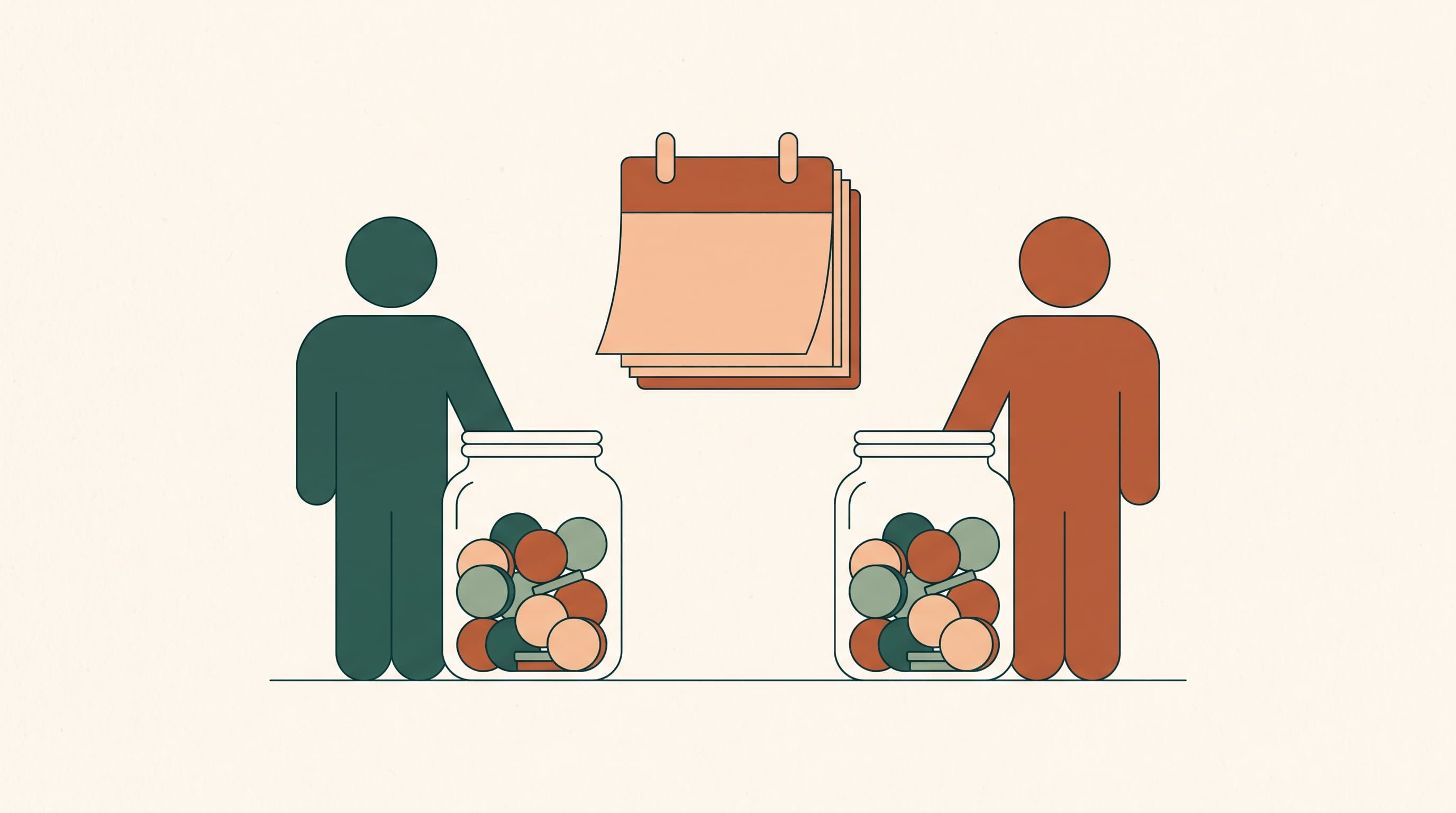
After three months you have a split that is down on paper and the first money conversations are behind you. The question "who actually pays for this?" disappears from daily life. After six months the irregular costs are in the system too: the insurance premium or a car repair no longer throws the split off balance. After a year the regular money moment has become a habit and the split adjusts along whenever an income changes. What remains is peace of mind: both of you know where you stand.
Conclusion: fair is what you agree on together
There is no mathematical formula that works out fairly for every couple. The numbers show that simple, transparent agreements are often experienced as fairer than refined calculations, and the law nowhere requires a 50/50 split. What does count: choosing consciously, including all costs and looking at it together regularly. With the four methods and the step-by-step plan from this article, you have everything you need to make those agreements today.
Want to put the split into practice right away without Excel calculations? Try PiggyPlanr for free: 14 days without obligation, no credit card or payment details.
Sources
- Nibud. "Geld & Relatie." 2019. https://www.kennisbundel.nl/wp-content/uploads/2019/06/Nibud-Rapport-Geld-en-relatie-2019.pdf
- Eurostat. "Gender pay gap statistics." Reference year 2024. https://ec.europa.eu/eurostat/statistics-explained/index.php?title=Gender_pay_gap_statistics
- City of Kortrijk. "Het huwelijk: wederzijdse rechten en verplichtingen" (art. 221 old Belgian Civil Code). https://www.kortrijk.be/het-huwelijk-wederzijdse-rechten-en-verplichtingen
- Advocaten.nl. "Levensonderhoud en kosten van de huishouding" (art. 1:84 Dutch Civil Code). https://www.advocaten.nl/levensonderhoud-en-kosten-van-de-huishouding-huwelijksvermogensrecht/
- Notaris.be. "Ongehuwde samenwoners: wat zijn ze aan elkaar verschuldigd?" https://www.notaris.be/nieuws/ongehuwde-samenwoners-wat-zijn-ze-aan-elkaar-verschuldigd
Frequently asked questions
Which splitting method is fairest when incomes differ?
There is no proven best method. The only representative study on perceived fairness, the Nibud report Geld & Relatie from 2019, even shows that users of the joint pot most often find their method fair (84%), followed by 50/50 (81%). Splitting pro rata to income scores lower (76%) and keeping the same amount left over lowest (68%). Fair is what the two of you agree on together, with open cards.
Do you legally have to split costs 50/50?
No. An equal contribution in absolute amounts is not legally required anywhere. For married couples, many European countries even apply the opposite: contributing according to means, as in Belgium and the Netherlands. De facto cohabitants sometimes have no legal duty to contribute at all, depending on the country, so there everything depends on your own agreements.
What is the 'keeping the same amount left over' method?
You add up both net incomes, subtract all shared costs and split what remains equally. If one earns 2,600 euros and the other 1,900 euros with 2,500 euros of shared costs, 2,000 euros remain and each gets 1,000 euros to spend freely. The contributions differ strongly (1,600 versus 900 euros), but neither has more spending money than the other.
How do you track a cost split without Excel?
A budget app with multiple contributors takes over the calculations. In PiggyPlanr you set a split per budget item: equal, unique (one partner pays), varying (each their own amount) or by ratio, where the app calculates each share automatically based on the entered incomes. Per partner you see their own contributions and what remains, and the app needs no access to your bank account.