All across Europe, employees receive part of their pay as a meal benefit. In Belgium it's called a meal voucher (maaltijdcheque), in France a titre-restaurant, in Italy a buono pasto and in Germany an Essenszuschuss. The names differ, but the principle is the same: there's an amount on a separate card that you can only spend on food, that sits apart from your bank account and that never shows up in any classic budget overview. As a result, many people don't know exactly how much they truly have to spend each month.
On top of that, 2026 is a special year: Belgium, France, Italy and Germany are all raising their amounts or ceilings at the same time. In this article you'll learn what meal vouchers and their European variants are exactly, what changes in 2026 per country and how to count that benefit correctly in your household budget. At the bottom you'll also find a simple way to solve that last part with a tool.
What are meal vouchers? One idea, many names
A meal voucher is a means of payment you receive through your employer. It feels like a little extra on top of your salary, but it actually isn't: it's simply part of your compensation package. The real gain lies in the tax treatment, and that principle is the same throughout Europe. Your employer's contribution is exempt from social security contributions and tax up to a legal ceiling. From that part of your pay you keep almost everything net, whereas a good chunk of a regular gross salary increase goes to taxes and contributions. A tax advantage that turns gross into almost net, that's how you could sum it up.
There are restrictions in return. You can only pay for food or meals with it: groceries at the supermarket, a sandwich during your lunch break or a restaurant visit. It used to be a paper voucher, today it's almost everywhere a card or an app. And in nearly every country the same rules apply: you receive the benefit per day actually worked, it's often valid for a limited time and you can't exchange it for cash.
Who is entitled to meal vouchers?
There's a persistent misunderstanding here: in none of the countries in this article is your employer legally required to provide meal vouchers or an equivalent. It's always a voluntary benefit, unless a sectoral collective agreement imposes it. If you do receive it, strict rules apply per country on amounts, contributions and use.
From British stopgap to European pay benefit
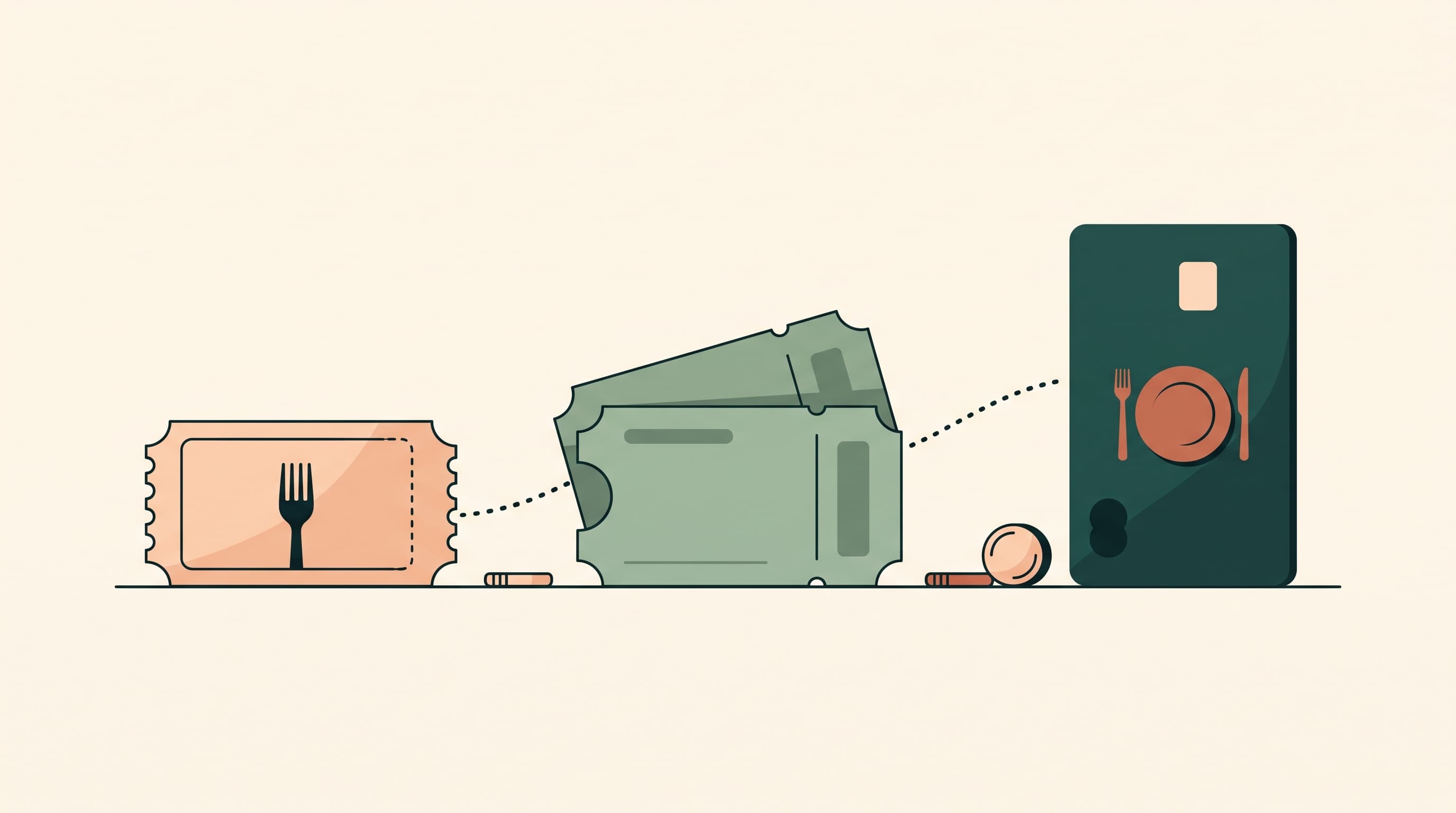
The idea is older than you'd think, and it has been a cross-border story from the very start. In the United Kingdom, the first "Luncheon Vouchers" appeared in 1946, during the post-war food shortage. French restaurateur Jacques Borel took inspiration from them and launched the "Ticket Restaurant" in 1962, which was legally recognized as a social benefit in 1967. Belgium introduced its meal vouchers as early as 1965, and from the seventies onwards the concept conquered the rest of Europe. Today almost every European country has its own variant, each with its own name and its own rules of the game.
What changes in 2026? The rules per country
If you think meal vouchers work roughly the same everywhere, think again. Each country has built its system in a fundamentally different way: Belgium fixes the value of the voucher by law, France works with a percentage rule, Italy rewards digital over paper and Germany doesn't even have a voucher but a daily allowance. These are the rules and the new amounts for 2026 in the four countries where something changes.
Belgium: from 8 to 10 euros per voucher
From 1 January 2026, the maximum value of a Belgian meal voucher rises from 8 to 10 euros. This is regulated in the royal decree of 10 November 2025. The maximum employer contribution goes from 6.91 to 8.91 euros, while the employee's minimum contribution remains 1.09 euros per voucher.
France: titres-restaurant with a daily cap
France takes a different approach. There is no legally fixed value for a titre-restaurant: the employer chooses the amount. What is fixed by law is that the employer contribution must be between 50 and 60 percent of the value, and that in 2026 this contribution is exempt up to 7.32 euros per titre (compared to 7.26 euros in 2025).
For the user, the spending cap matters most: you can spend a maximum of 25 euros per day with titres-restaurant, a limit unchanged since October 2022. Titres remain valid until the last day of February of the following year.
Italy: electronic buoni pasto up to 10 euros per day
Italy works with two tracks. For electronic buoni pasto, the tax-free threshold rises in 2026 from 8 to 10 euros per day, thanks to the 2026 budget law (law no. 199 of 30 December 2025). Paper buoni pasto stay stuck at 4 euros per day. The Italian legislator's message is clear: digital is rewarded.
If you receive more than the threshold, the surplus is simply taxed as salary. And a practical rule at the checkout: you can use a maximum of 8 buoni pasto per transaction.
Germany: Essenszuschuss up to 7.67 euros per working day
Germany has no separate meal voucher statute, but a combination of two amounts. The official "Sachbezugswert" for a lunch or dinner is 4.57 euros per day in 2026. On top of that, the employer may add a tax-free supplement of 3.10 euros. Together that's a maximum of 7.67 euros per working day free of tax and social contributions, compared to 7.50 euros in 2025.
The conditions are typically German in their precision: the supplement applies per day worked, you must be able to prove with a receipt that you actually bought a meal and the meal may not cost more than 60 euros.
And the rest of Europe?
The story doesn't end with these four countries. Spain has the cheque restaurante, Portugal the subsídio de alimentação, Luxembourg the chèques-repas, Czechia the stravenky and Poland the lunch card. The philosophy is the same every time: a tax-favoured amount for meals, with its own national amounts and conditions. So always check the current rules of your own country, because the amounts are adjusted regularly.
The four systems side by side
| Belgium | France | Italy | Germany | |
|---|---|---|---|---|
| Local name | Maaltijdcheques | Titres-restaurant | Buoni pasto | Essenszuschuss / Restaurantscheck |
| Exempt amount 2026 | Employer contribution max. 8.91 euros per voucher | Employer contribution max. 7.32 euros per titre | 10 euros per day (electronic), 4 euros (paper) | 7.67 euros per working day |
| Value of the voucher | Max. 10 euros (fixed by law) | Free to choose, employer pays 50 to 60% | Free, threshold determines tax-free part | No voucher, but a daily allowance |
| Notable rule | Valid max. 12 months, electronic only | Daily cap of 25 euros | Max. 8 buoni per transaction | Receipt as proof, meal max. 60 euros |
Amounts based on each country's official regulations for 2026, see the list of sources at the bottom.
How to count meal benefits correctly in your household budget
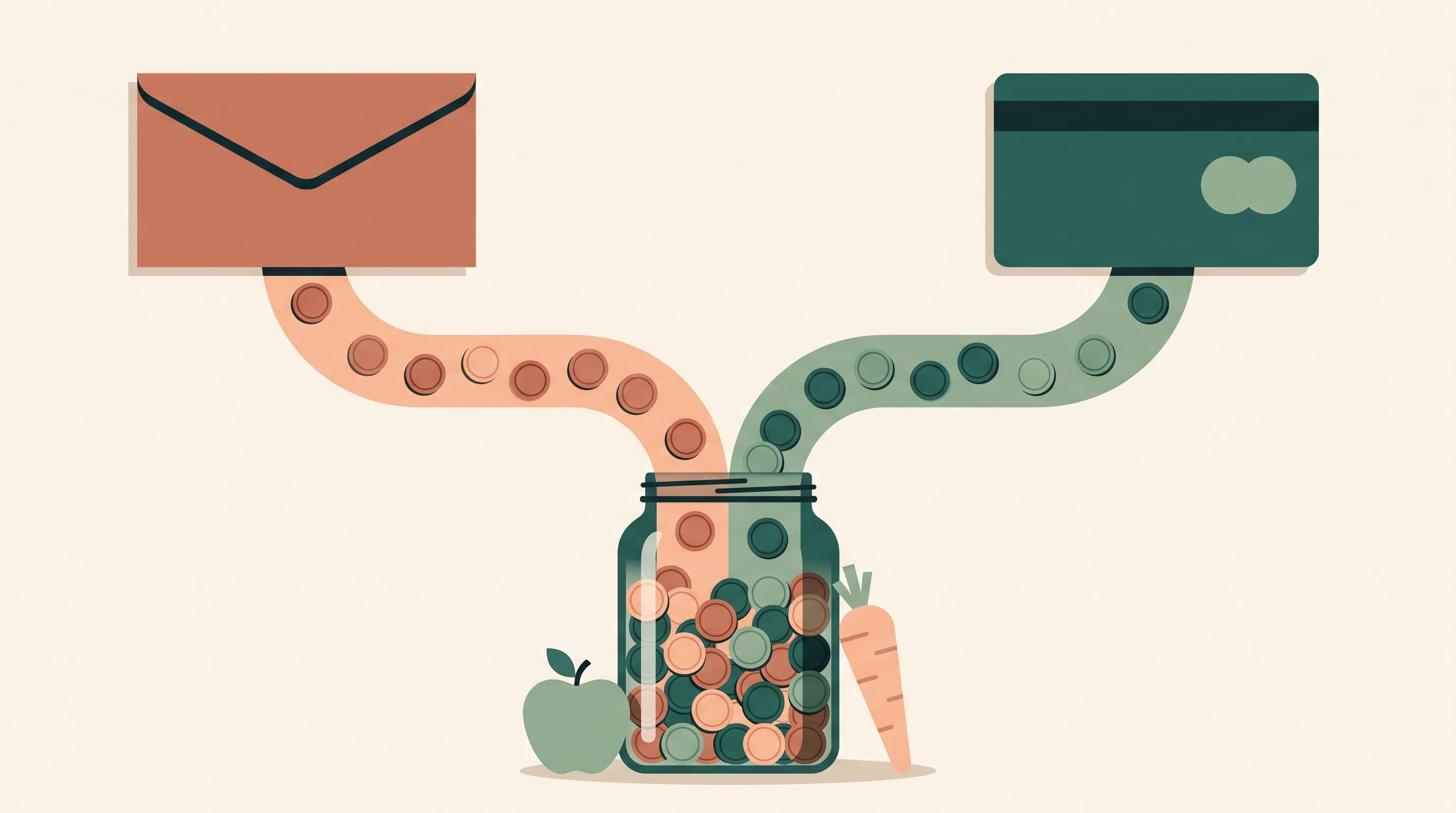
Now the practical part, and it's the same in every country. Meal vouchers are a separate pot next to your bank account, and that's exactly where things go wrong for many households. There are two classic mistakes:
- You don't count the benefit as income. Then your grocery budget seems to weigh more heavily on your salary than it actually does, and you set aside too much.
- You record expenses paid with the card as if they came from your account. Then it looks like you spend more than actually leaves your account, and your overview is off as well.
With this step-by-step plan you avoid both mistakes, wherever you work.
Step 1: estimate what you receive on average per month
The basic formula is simple: the number of days worked per month times the daily value of your benefit.
Step 2: count that amount as income for food
Treat your meal benefit as a second income stream that is exclusively destined for your grocery pot. Your total food budget is then: what you set aside from your salary, plus the average value of your vouchers or daily allowance. That way you immediately see how much salary room is freed up for other items, such as saving or outings.
Step 3: record the correct payment source for every expense
If you pay for groceries with your benefits card, record it that way. If you pay split, for example 40 euros with the card and 25 euros from your account because the balance wasn't enough, then split your registration too.
One receipt, two payment sources
Worked example from the article: you pay € 40 with your benefits card and € 25 from your account. Both pots drop by their own share, while the groceries category shows the full amount.
If you don't, you get a distorted picture. One month you seem to have spent remarkably little at the store and the next month suddenly much more, while that difference comes purely from how you happened to pay with your vouchers. Only by recording the correct payment source for every expense do you get an honest and correct picture of what you actually spend on groceries.
Step 4: keep an eye on your balance and expiry dates
In most countries the benefit is valid for a limited time: Belgian vouchers expire after a maximum of 12 months, French titres at the end of February of the following year. A balance that keeps growing for months is therefore a signal that you're paying too little with the card. Turn it around: pay for your groceries first with your meal benefit and only then from your account.
Budgeting with a tool that knows meal vouchers
You can track all of this in a spreadsheet, but it takes a lot of time and discipline: entering every expense, manually splitting every mixed payment over two columns, tracking the voucher balance separately. That quickly becomes dozens of rows per month that you have to fill in and check yourself.
You'd expect a budget app to take over that work, but most apps simply don't know the concept of meal vouchers, in any of its European guises. And that grates. Those vouchers are part of your pay, part of what you spend each month and thus part of what you want to be able to budget. A budget system that can't handle them simply leaves a piece of your financial picture out of view.
A budget app that can handle them is PiggyPlanr, a budget tool for households that treats meal benefits as a full part of your budget. The feature is built for Europe: it supports meal vouchers, titres-restaurant, buoni pasto, the German Sachbezugskarte and the variants in Spain, Portugal, Luxembourg, Czechia and Poland. You set up once what you receive, as a fixed amount, as a number of vouchers per month or as a variable amount, and link the benefit to a budget item, usually your groceries.
After that, the calculations happen by themselves. During the monthly processing, the tool automatically books the deposit and adds the value of the benefit to your income, so your surplus adds up. For every expense you choose the payment source: account, extralegal benefits, cash or a combination. One store visit can thus be split, with each pot decreasing by the right amount. A dashboard widget shows your current balance and the deposit history per month.
Conclusion: from loose pot to full budget component
2026 brings higher amounts for meal vouchers and their local variants in Belgium, France, Italy and Germany at the same time. Each country arranges it differently, but for you as a recipient it comes down to the same thing everywhere: a separate pot of money for food that you have to actively count in to get an accurate picture of your household budget. With the four steps from this article you'll know exactly what you have to spend from now on, no voucher will expire unused anymore and salary room is freed up for the things you really care about.
Sources
- Unisoc, Maaltijdcheques: de maximale waarde stijgt van 8 naar 10 euro
- Partena Professional, Finale go voor maaltijdcheques van 10 EUR vanaf 2026
- FOD Werkgelegenheid, Fiche sectoraal overleg 2025-2026: maaltijdcheques
- Service-Public.fr, Titres-restaurant : augmentation du plafond d'exonération
- Conecs, Réévaluation du plafond d'exonération des titres-restaurant au 1er janvier 2026
- Fisco7, Buoni pasto: nuovo limite di esenzione dal 2026
- Edenred Italia, Aumento soglia esenzione buoni pasto nel 2026
- Pluxee Deutschland, Sachbezug 2026: aktuelle Werte für Mitarbeiter-Benefits
- IHK Rhein-Neckar, Steuerfreie Arbeitgeberleistungen 2026
- VLH, Essensgutschein: Mittagspause steuerfrei genießen
- Wikipedia, Meal voucher (history of Luncheon Vouchers and Ticket Restaurant)
- Néorestauration, Le titre-restaurant a 50 ans
Frequently asked questions
Is my employer required to provide meal vouchers?
No. None of the countries discussed have a legal obligation. It is a voluntary benefit, unless a sectoral collective agreement makes it mandatory.
Do the amounts rise automatically everywhere in 2026?
No, and it differs per country. In Belgium the increase to 10 euros has to be laid down per sector or per company in a collective agreement or an individual agreement. In France and Italy only the legal exemption ceilings rise; how much you actually receive is up to your employer. So ask your employer or check your sectoral agreements.
Can I exchange meal vouchers for cash?
No, that is not allowed. The benefit can only be used for food and meals and is valid for a limited time in most countries, in Belgium for example a maximum of 12 months.
Do meal vouchers count as income in my budget?
For your household budget they do, and that is exactly the point of this article: treat them as a separate income stream destined for food. Fiscally, within the legal limits, they are precisely exempt from tax and social contributions.